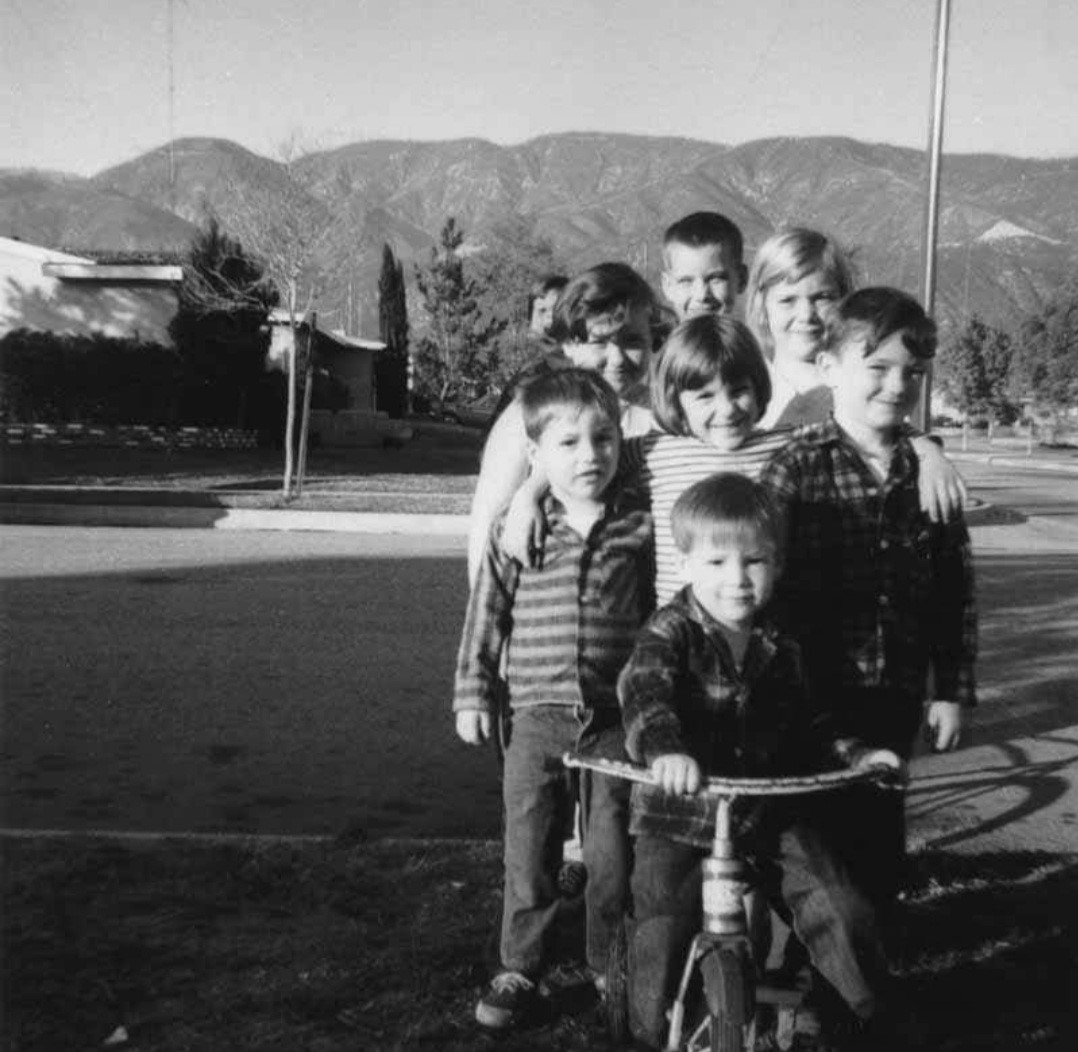
That's me, Timothy Eldridge (far right, middle row), and that's Cindy Perkins with her arm around me; I was always a little sweet on her.
I can freely admit that today, but when this picture was taken I would've dissolved into the asphalt if she'd found out. I was 9 and she was 9 and 1/2 ... it always bugged me that she was older.
The picture was taken in the fall of 1967, and it would be a seminal year in my life.
The day this photograph was taken was like a hundred other days I'd spent on E. 49th Street. Up until then my life in San Bernardino could only have been described as idyllic and carefree.
My family moved to 232 E. 49th St. in 1963. It wasn't a big house, maybe 1200 square feet, but it seemed like a palace compared to the cramped little apartment we'd been living in since my mom married her 2nd husband.
By the time I was born, my father had died. He and my mom were married a little over a year when he was killed just outside of Amarillo, Texas. He was a long-haul truck driver, and the story goes that he'd been driving too long and fell asleep at the wheel. He was 21 years old.
The accident happened in April, and I was born fatherless in July of 1958.
Later that year my mother took a part-time job at the local Market Basket grocery store, and that's where she met my future stepfather, Sander Eldridge. He was the store manager and considerably older: he was 35; she was 20, but despite their age difference they fell in love and married in August of 1961. I was 3 years old and couldn't have asked for a better stepfather. He embraced me as his own and legally adopted me soon after they married.
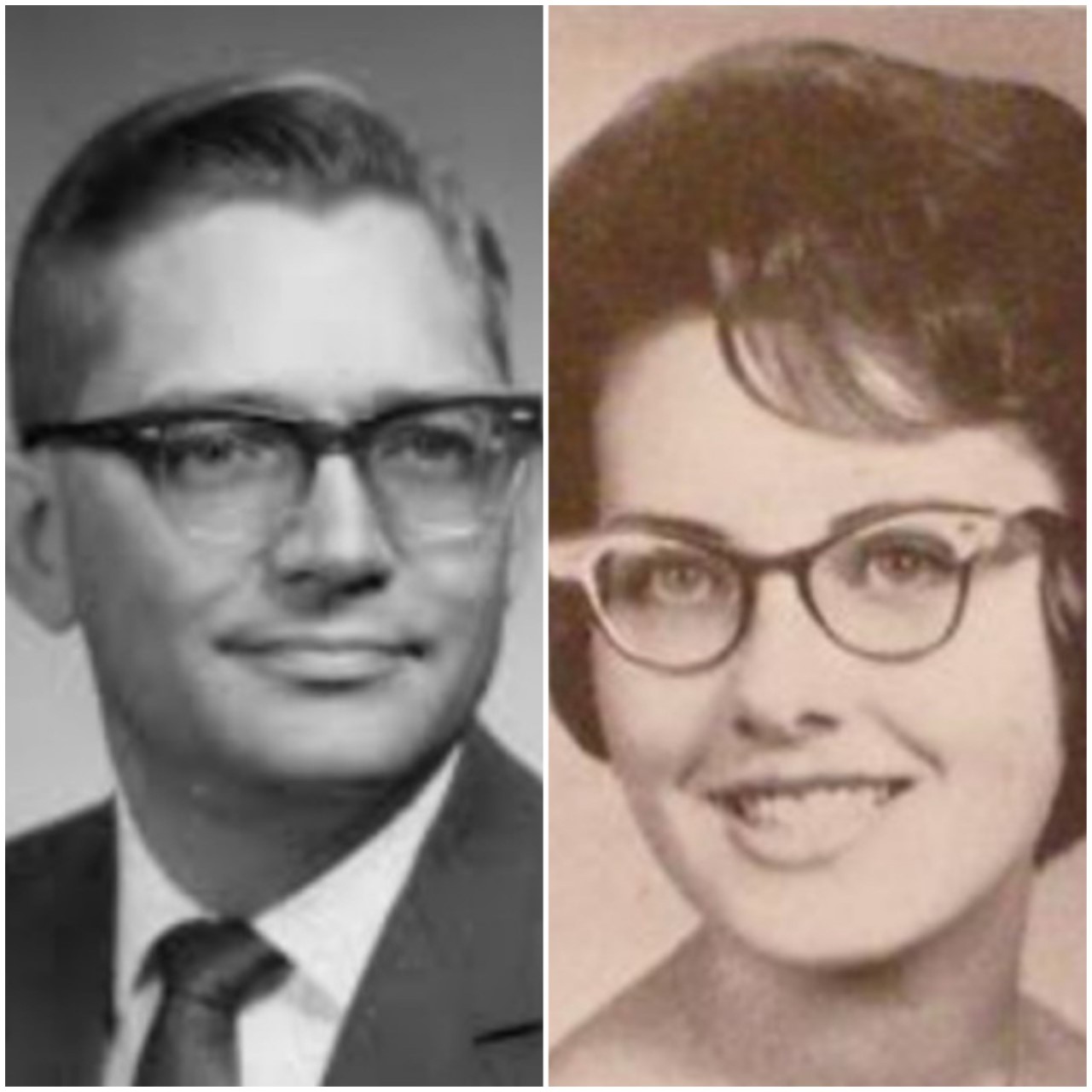 |
| Sander and Esther Eldridge |
My step-father was a divorced man with a son from his previous marriage. That son, William Sander Eldridge, was 13 when his father married my mom. He lived full-time with his mother, but spent one weekend a month and two weeks in the summer with us. He was a troubled young man ... everyone called him Billy.
Our new E. 49th Street neighborhood consisted almost exclusively of young families with children, several of whom were my age. Together we kids ran through the sprinklers during the hot San Bernardino summers; we rode bikes, played tag, baseball, and hide and seek. It was a picture perfect childhood, except for one weekend a month and two weeks in the summer.
Those visits from my step-brother were always difficult. Our normally tranquil home became tense and uncomfortable as he pressed the boundaries of what our father was willing to allow. During his stays he and I had very little interaction, which suited me just fine - I was afraid of him, and for the most part he left me alone. Then one day, all of a sudden, he stopped coming.
Turns out that he and a couple of his ne'er-do-well friends had been arrested for stealing the neighbor's Studebaker and taking it for a joyride; and that was the final straw for his mother. She and our father decided that sending him to a home for incorrigible boys was the only solution, which they did in the fall of 1964. I wouldn't see my step-brother again for over a year.
Upon his release from the boy's home his mother announced that she was unwilling to have him back, so Billy came to live with us full-time. At first I was terrified, but right away I noticed a difference: he was calmer and uncharacteristically polite to my mom and stepdad; and what was especially surprising - he began to pay attention to me.
He started calling me "Sport" and offering to throw the football with me in the front yard. He began inviting me into his room in the evening to listen to his records (he was quite partial to the Rolling Stones), and it wasn't long before I knew every word to, As Tears Go By, 19th Nervous Breakdown, Heart of Stone, Not Fade Away, et al: basically the entire High Tide and Green Grass album.

I didn't quite know what to make of all this attention, but I liked it. He was becoming a big brother to me, and suddenly I found everything about him fascinating.
Some mornings I'd sit on the edge of the tub and watch him shave; other times I'd listen with rapt attention as he told me funny stories about his time in the boy's home. Some days he'd take me and a couple of my friends along with him to the park where we'd play while he smoked cigarettes and flirted with the girls. And he didn't have to ask me to keep quiet about the cigarettes; I understood that that was something to keep to myself, and I was excited to have a secret just between the two of us.
I was completely infatuated, and it wasn't long before I decided that I wanted to be just like him.
Those were happy days, and all was well and wonderful on E. 49th Street until the day it wasn't.
It was early April when Billy received an official looking letter in the mail. He tore open the envelope, and inside discovered those dreaded words:
Greetings,
You are hereby ordered for induction into the Armed Forces of the United States.

Once he learned he was drafted, it wasn't long before he was off to Fort Ord for basic training. Mom and Dad drove him to the bus station and I tagged along. When it came time for Billy to board the bus, my stepdad shook his hand and my mom gave him an awkward hug. As he turned to say goodbye to me I started to cry, which really embarrassed me, but I couldn't help it. In response to my tears, he knelt down and tousled my hair; assuring me that it would only be a couple of months before he'd get to return home for a visit.
As the door to the bus closed and the diesel engine revved up, I waved goodbye to my favorite person in the whole wide world.
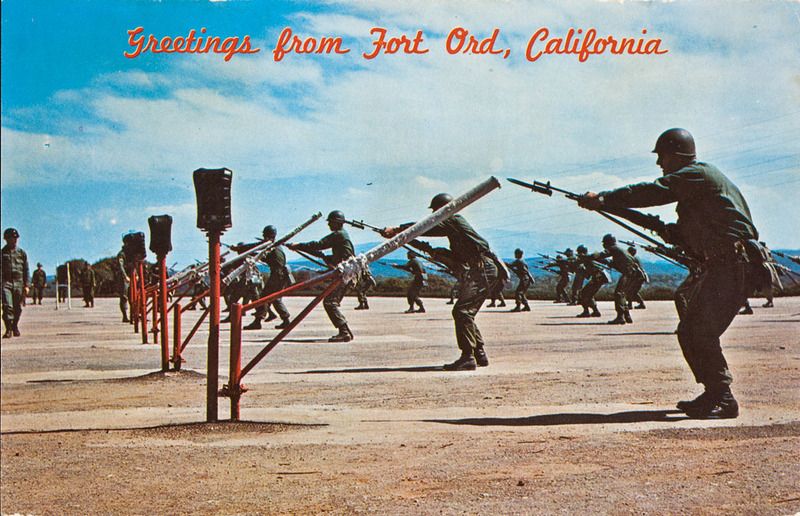
Within a week of his departure we received a postcard. On the back he briefly detailed some of what he was experiencing in basic training, and before he closed, he wrote a special message of encouragement to me, his "little buddy," and I was thrilled.
In early July he returned home fifteen pounds lighter and sporting a funny looking haircut. He regaled us with colorful stories about his time in boot camp and spoke as if he enjoyed his new military life, which he said he looked at it as a great adventure.
You could tell that our father was proud of the man Billy had become. I'm sure he never imagined that this once "incorrigible" boy would grow up to be a proud U. S. Army soldier. All I cared about was the fact that he was home and that he'd be there for my 8th birthday.
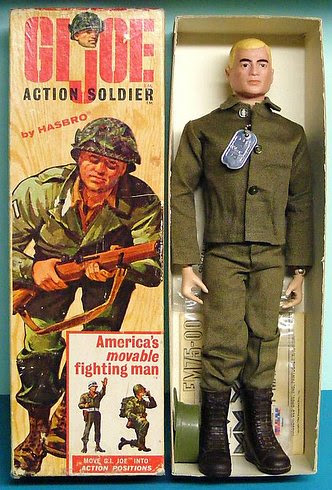
When that day finally came, we had a party in the backyard, and of all the gifts I received that day, the one I treasured most was the one he bought me. It was the G.I. Joe I'd asked for , but didn't get, the previous Christmas.
I was elated.
The first couple of days he was home he spent with his mother, but the rest of the time he stayed with us, and he spent most of that time cruising around town in mom's car and visiting with his friends.
There were nights at the local drive-in restaurant and long, lingering days spent at the beach; and I got to go along on some of those outings. When I did, he had me sit up front, shotgun, while he drove far too fast and played the radio much too loud. I was in heaven, and to this day some of the fondest memories I have are of those sunny days and warm, noisy nights we spent together that summer.
When the day came for him to leave, I was crushed. My only consolation was that before he left he gave me permission to go into his room anytime I wanted and listen to his records.
Once he arrived at Fort Polk for infantry training, I began writing him twice a week. My mom bought me an Army-themed
coloring book, and I'd send him a page I'd colored along with each of my letters. Most of the coloring book pages depicted soldiers in combat, so along the edge of the page I'd write his name with an arrow pointing to the "good guy." In his letters home he thanked me for writing and told me how much it meant to him.
Upon completion of his AIT (Advanced Individual Training) he sent word that he was about to be shipped out to Vietnam. To me, Vietnam was a mysterious, far away place, and I had no idea why he was going there. Though my father tried to explain the situation, none of it made any sense to me. All I knew was that my beloved brother was not home, and wouldn't be for a long time.
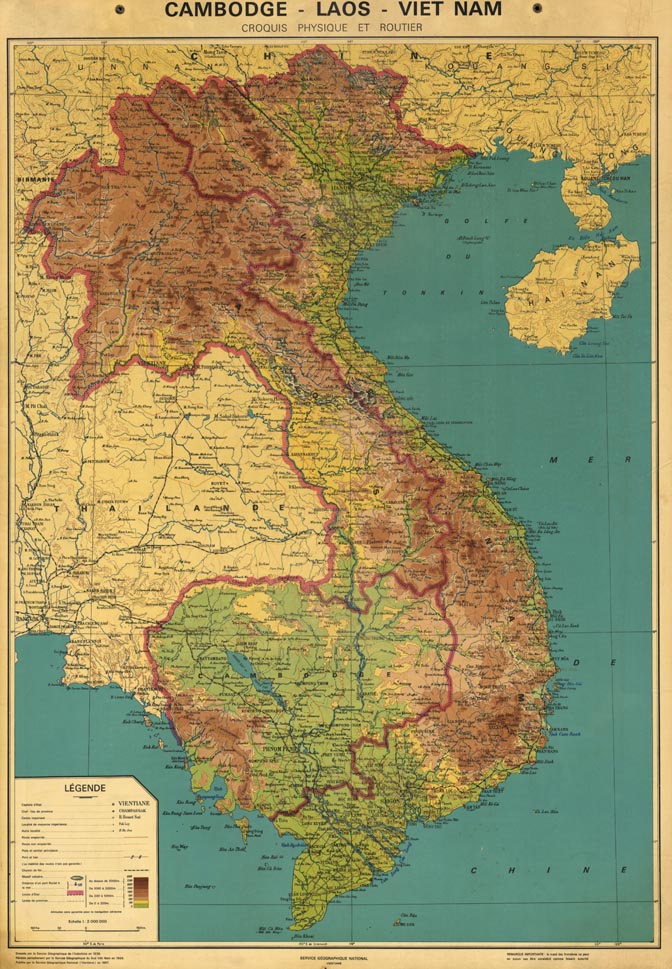
Once he arrived in Vietnam he wrote telling us all about the strange new land he'd been dropped into the middle of: the smells, the oppressive heat and humidity, and the hundreds of poor and desperate people he regularly encountered. For the first couple of months he seemed convinced that the cause he was there to fight for was a noble one, and he was excited to be a part of it. But before long his letters became less frequent, and those that we did receive had a completely different tone.
He no longer spoke of the experience as a noble and exciting adventure; in fact, his words began to suggest that he was simply trying to survive until his mandatory "in country" service was complete. In the last letter my folks received, he stated that he'd become disillusioned with the mission, and he bemoaned its futility.
But I wasn't aware of all that. He was my hero, and when I wasn't bragging to my friends about how my big brother (by then I'd dropped the "step" designation) was a brave soldier in
the United States Army, I was lying on his bed listening to his records and looking forward to the day he returned.
Then came the Monday before Thanksgiving. All of us kids were playing kick ball in the street when our game was interrupted by a gray sedan driving slowly up the street. We stepped aside until it passed and then we returned to our game. In the midst of all the fun we were having, I didn't notice that the gray sedan had stopped and parked in front of our house.
No more than 10 minutes later I heard my mom frantically calling me home. I turned to see her standing on our front walk, while two men in military uniforms got into the gray car and pulled away. I ran as fast as I could to the house, and when I got there she rushed me inside and told me to go straight to my room. It was obvious that something was very wrong, so I did as I was told and didn't ask questions.
Sitting on the edge of my bed, I could hear my mother speaking with great animation to someone on the phone, but I couldn't make out what she was saying.
It wasn't long before I heard my father come through the front door. Seeing as how it was the middle of the day, I knew something very serious must've happened. While I desperately wanted to know what was going on, I was too afraid to leave my room and ask.
It would be several years before I learned the official story: my brother and 18 other men from his unit had been killed by mortar fire during the battle of Dak To.
Perhaps my parents figured that since I was only nine I shouldn't be given the precise details - I don't know, but for whatever reason, all my father told me that day was that something had happened over in Vietnam and that I was going to go stay with my grandparents for a couple of days.
I wasn't very close with my grandparents; they were first-generation Lithuanian immigrants: stern and quiet people who rarely had much to say to me under normal circumstances, so it's no surprise that they didn't bother to explain the situation either.
I suppose that in the midst of all the swirling chaos of the next few days, everyone just assumed that I knew what had happened. But their assumption was wrong.
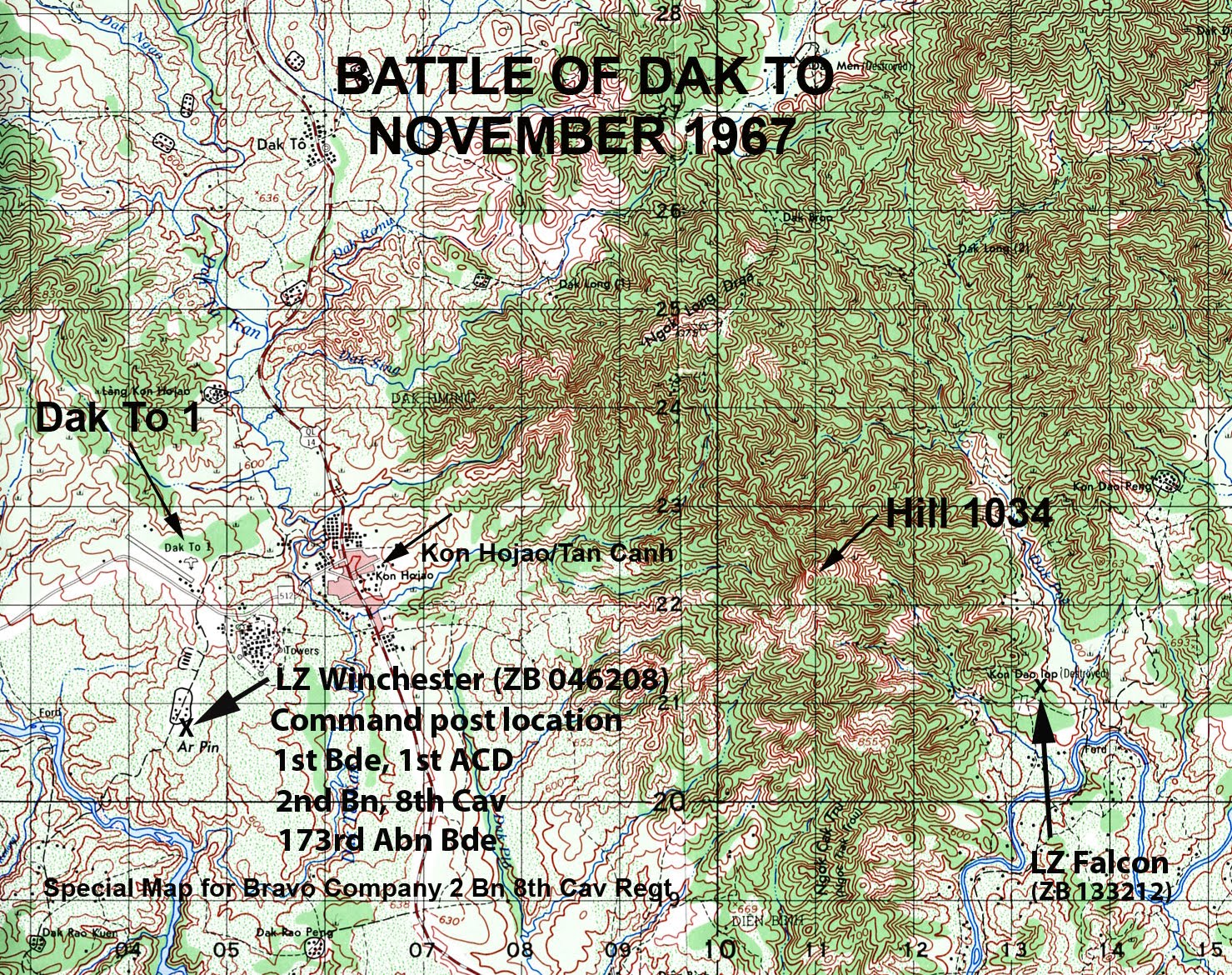
As crazy as it sounds, when we walked into the church on the day of the funeral, I turned to my father and asked if he knew when Billy would be coming home. When I did, he gave a puzzled look as he pointed to the casket at the front of the church and informed me that he was home.
I sat in the pew with my parents as the preacher droned on, but I heard none of it. I was too busy trying to deal with the powerful emotions running through my nine year old head; emotions that I'd never felt before.
After the service we returned to our house, which quickly filled with people. Friends and family members greeted me, and a couple of well-meaning aunts hugged and kissed me, but a great chasm of grief had formed inside me; a chasm which their gestures of kindness couldn't span.
What does a 9 year old boy do when the man he admired most in life vanishes into thin air?
What followed were days upon days of blur and sadness. Dreams were the only way I could still be with him, and in my dreams we were always together, laughing and happy. When morning would come, all I wanted to do was go back to sleep and continue dreaming.
Recognizing the profound emotional impact my brother's death had had on me, my sweet mother asked Billy's mom for some photographs of him, which she had copied and then put them together in a scrapbook for me.
In the evening I would lie on his bed and listen to his records while flipping through the pages of that scrapbook. I'd closely examine each picture and wallow in my grief.
Though it took some time, eventually my overwhelming sadness began to subside. What were once constant thoughts of him became frequent thoughts, and over time those frequent thoughts became occasional thoughts.
You know - time is a funny thing; and, as is often said, "waits for no one." Eventually weeds grow up around the tombstones, flowers get left less often, and time marches on.
Despite the tragedy of Billy's death, life on E. 49th Street also marched on. For us kids, elementary school turned into junior high school, and then we were off to San Bernardino High, where, believe it or not, I began dating Cindy Perkins, my childhood "secret love."
After obtaining a Business Degree from the UC Santa Barbara, I returned home to San Bernardino and took a job with Citizens Bank.
Mom eventually became a widow for a second time and continued to live alone in that little house on E. 49th Street until the day she, too, passed from this life.
Years before, she'd turned my old room into a guest room, but she chose to leave Billy's room just as it was when he last left it.
Occasionally I'd wander down the hall and dust off his albums, just as I'd promised him I'd do. I'd sit on the edge of his bed and listen as The Rolling Stones took me back in time.
Eventually I married, but in the most bizarre twist of all, it wasn't to Cindy Perkins, but to her younger sister, Carol; which made for a few awkward holiday gatherings.
My wife has always understood the special place Billy held in my heart, so when we discovered that our son was on the way, I asked her if we could honor my brother's memory by naming our boy after him. When she said, 'yes,' I cried over the loss of my brother for the first time.
And so it would be; on a warm September afternoon - pink and screaming - our precious little man entered the world as William Timothy Eldridge, but everyone just calls him Billy.
"I sit and watch as tears go by"


